Your online reputation is your dental practice's most powerful marketing asset. Before a potential patient ever calls your office or visits your website, they read your Google reviews. Studies show that over 90 percent of patients use online reviews to evaluate healthcare providers, and most will not consider a practice with fewer than four stars.
Building and maintaining a strong online reputation is not about gaming the system — it is about consistently delivering great care and making it easy for satisfied patients to share their experience. Here is how to do it.
Why Online Reviews Matter More Than Ever
The landscape of how patients find and choose a dentist has fundamentally changed. Word-of-mouth still matters, but it has moved online. When someone needs a new dentist, their journey almost always starts with a search engine.
The numbers tell the story
- 93 percent of patients say online reviews influence their choice of healthcare provider.
- 72 percent of patients use Google reviews as their first step in finding a new doctor or dentist.
- A one-star increase in your Google rating can lead to a 5 to 9 percent increase in revenue.
- Practices with fewer than 10 reviews are often overlooked entirely, regardless of their actual quality of care.
Your Google rating is not just a vanity metric. A strong rating is one of the most effective ways to attract new patients to your dental clinic. It — it directly impacts how many new patients find and choose your practice.
Claim and Optimize Your Google Business Profile
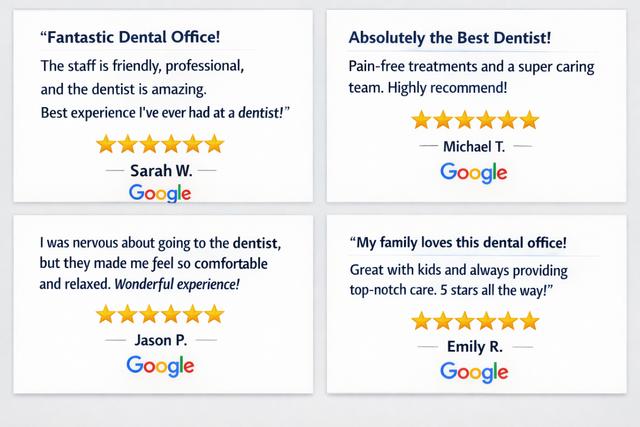
Before you can build a great review presence, you need to make sure your Google Business Profile is complete and optimized.
Checklist
- Claim your listing at business.google.com if you have not already.
- Verify your business through Google's verification process.
- Complete every field: practice name, address, phone number, website, hours, services, insurance accepted.
- Choose the right categories: "Dentist" as primary, with subcategories like "Cosmetic Dentist," "Pediatric Dentist," or "Orthodontist" as applicable.
- Add high-quality photos: exterior, interior, treatment rooms, waiting area, and team photos.
- Write a compelling business description that includes your key services and what makes your practice unique.
A complete profile ranks higher in local search results and looks more trustworthy to potential patients browsing their options.
Ask for Reviews — Consistently and Systematically
The biggest reason most dental practices do not have enough reviews is simple: they do not ask. Happy patients are willing to leave a review, but they rarely think to do it on their own. You need to make asking a routine part of your workflow.
When to ask
- Right after a positive experience — the end of a successful appointment is the perfect moment.
- After completing a treatment plan — patients who have been through a multi-visit procedure feel a sense of accomplishment.
- When a patient gives verbal praise — if they tell you or your staff how happy they are, that is your cue.
How to ask
- In person: Train your front desk team to say something like, "We're so glad you had a great experience. Would you mind sharing it with a quick Google review? It really helps other patients find us."
- Via text or email (using dental practice management software to automate follow-ups): Send an automated follow-up message after the appointment with a direct link to your Google review page.
- With signage: Place a small sign or card at the front desk with a QR code that links directly to your review page.
The key is to make leaving a review as easy as possible. The fewer clicks, the more reviews you will get.
Never miss a review request
Trigger a review request on the same automation rails as WhatsApp appointment reminders — the day after a visit, while the experience is still fresh in the patient's mind. WhatsApp reminders work especially well for this: reply rates are high, and patients often tap through to leave a review within minutes.
Create a direct review link
Google provides a shortcut URL that takes patients directly to the review form for your business. Share this link in your follow-up messages, on your website, and in your email signature.
To find your link:
- Go to your Google Business Profile.
- Click "Ask for reviews."
- Copy the short link provided.
Respond to Every Review

Responding to reviews — both positive and negative — shows that you value patient feedback and are actively engaged with your online presence.
Responding to positive reviews
Keep it genuine, brief, and personal:
- Thank the patient by name (if they used their real name).
- Reference something specific if possible: "We're glad the whitening treatment exceeded your expectations!"
- Invite them back: "We look forward to seeing you at your next visit."
Responding to negative reviews
Negative reviews are inevitable. How you respond to them matters more than the review itself. Potential patients reading your reviews will pay close attention to how you handle criticism.
Do:
- Respond promptly — within 24 to 48 hours.
- Stay calm, professional, and empathetic.
- Acknowledge the patient's frustration without being defensive.
- Take the conversation offline: "We'd like to make this right. Please call us at [phone number] so we can discuss this directly."
- Follow up privately to resolve the issue.
Do not:
- Argue with the reviewer or get defensive.
- Disclose any patient health information (this violates privacy laws).
- Ignore negative reviews — silence looks like indifference.
- Post fake positive reviews to counteract a bad one.
A thoughtful, professional response to a negative review can actually build trust. Potential patients see that you take feedback seriously and care about resolution.
Encourage Reviews Without Crossing the Line
There are right ways and wrong ways to build your review count. Ethical review practices protect your reputation and keep you in compliance with Google's policies.
What you should do
- Ask genuinely satisfied patients to share their experience.
- Make it easy with direct links and QR codes.
- Follow up with a friendly reminder if a patient expressed interest but has not left a review yet.
- Thank patients who leave reviews (verbally at their next visit).
What you should never do
- Offer incentives for reviews — discounts, gifts, or contest entries in exchange for reviews violate Google's terms of service and can result in your reviews being removed.
- Buy fake reviews — these are easy to spot, damage credibility, and can lead to Google penalties.
- Review-gate — do not screen patients first and only ask those you think will leave positive reviews. Ask everyone and let the results speak for themselves.
- Write reviews yourself or ask staff to post reviews.
Authenticity is everything. A mix of mostly positive reviews with the occasional constructive criticism actually looks more credible than a perfect five-star rating with generic comments.
Monitor Your Online Presence Beyond Google
While Google is the most important review platform for dental practices, patients may also leave reviews on other sites. Stay on top of all of them.
Platforms to monitor
- Google Business Profile — your primary focus.
- Yelp — still widely used, especially in urban areas.
- Facebook — patients may leave recommendations on your practice's Facebook page.
- Healthgrades and Zocdoc — healthcare-specific directories where reviews carry weight.
- Your own website — consider adding a testimonials section featuring patient quotes (with permission).
Set up Google Alerts for your practice name so you are notified whenever your practice is mentioned online.
Leverage Social Proof on Your Website
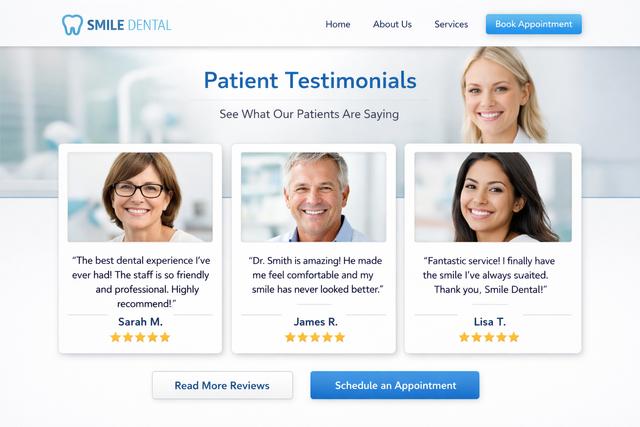
Your website should showcase the positive reputation you are building. Social proof reassures potential patients that they are making the right choice.
Ways to feature social proof
- Embed Google reviews directly on your homepage or a dedicated testimonials page.
- Display your average rating prominently — "Rated 4.9 stars on Google with 200+ reviews."
- Feature patient stories (with consent) that highlight transformative treatments.
- Show trust badges: professional memberships, certifications, and awards.
When a potential patient lands on your website and immediately sees glowing reviews, it reinforces the positive impression they formed from your Google listing.
Handle Negative Feedback as a Growth Opportunity
Not every piece of negative feedback is unfair. Sometimes a bad review reveals a genuine problem in your practice — long wait times, unclear billing, unfriendly staff, or poor communication.
Turn criticism into improvement
- Look for patterns in negative reviews. If multiple patients mention the same issue, it is a real problem that needs addressing.
- Share feedback with your team constructively and work together on solutions.
- Follow up with unhappy patients after resolving the issue. Some will update or remove their negative review when they see you took action.
- Document changes you have made in response to feedback — this shows a commitment to continuous improvement.
The best dental practices treat reviews as a feedback loop, not just a marketing tool. This data-driven approach also helps you reduce patient no-shows by understanding what patients value.
Build a Review Culture Within Your Practice
Generating reviews should not be one person's responsibility. It should be part of your practice culture.
How to build this culture
- Train every team member to recognize review-worthy moments and know how to ask.
- Set a monthly goal for new reviews and celebrate when you hit it.
- Share positive reviews with the team — reading a patient's kind words boosts morale.
- Make review requests part of your checkout process — it takes 30 seconds and becomes second nature.
When asking for reviews becomes a natural part of every patient interaction, the results accumulate quickly.
Track Your Progress
Like any business initiative, reputation management should be measured and tracked.
Metrics to monitor
- Total review count on Google and other platforms.
- Average star rating — aim for 4.5 stars or above.
- Review velocity — how many new reviews you receive per month.
- Response rate — what percentage of reviews you have responded to.
- Sentiment trends — are reviews trending more positive or more negative over time?
Review these metrics monthly and adjust your strategy accordingly.
The Bottom Line
Building a 5-star online reputation is not a one-time project — it is an ongoing commitment to delivering excellent patient experiences and making it easy for patients to share them. Ask consistently, respond to everything, handle criticism with grace, and let your happy patients become your most powerful marketing channel.
The practices that thrive in 2026 and beyond will be the ones that take their online reputation as seriously as their clinical outcomes. Start today, stay consistent, and watch your practice grow.